Showing posts with label the word of God. Show all posts

Wednesday, April 27, 2011

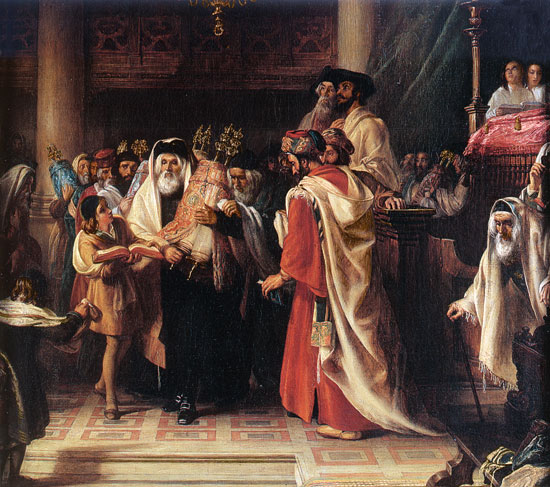
The King's Scroll

The 17th mitzvah is that we are commanded that every king who sits in rulership over the Jewish people shall write a Sefer Torah for himself; and that it shall never be separate from him.
Translated by Rabbi Berel Bell
Sefer Hamitzvot in English
The King's Torah Scroll
Chabad.org

"It shall not move from his presence except when he enters the bathroom, the bathhouse, or a place where one is forbidden to study. When he goes out to war, it must be with him; when he returns, it must be with him; when he sits in judgment, it must be with him; when he eats, it must be in front of him."
Rambam, Hilchos Melachim, Chapter 3, Halacha

"I will rise up at midnight to give thanks to You for Your righteous judgments." -Psalms 119:62

According to Deuteronomy 17:18, each King of Israel is to write for himself a copy of the Torah scroll. The Talmud interprets this as meaning the King will write two scrolls, one to be kept in the Treasury, and one to be kept, as we see in Rambam's commentary above, with the King at all times. If God's justice and mercy is before the King every waking moment, when he's eating breakfast, when he goes to war, when he sits in his home, when he goes along the way, then God's judgments will not be far from the King when the King issues his judgments over the people of Israel.

We who are disciples of the Jewish Messiah Jesus (Yeshua) have one King. If we are true to our faith, then he and his righteous judgments are always before us. He is our living Torah. But is he his own living Torah?
The Word became flesh and made his dwelling among us. We have seen his glory, the glory of the one and only Son, who came from the Father, full of grace and truth. -John 1:14
It's common in Messianic circles to consider Jesus as the living embodiment of the commandments of God, the flesh and blood container for all of God's mercy, compassion, judgments, and ordinances, the Torah incarnate who dwelt among us. As the suffering servant, he set aside his Kingship and his majesty and he died, although he died with the titulus ironically declaring his Kingship nailed above his head. When he returns, he will come as avenging King. When he walked among men as a man, he obeyed all of the mitzvot without error or flaw. As King, he can do no less. But how will the King keep the Torah before him at all times?
I saw heaven standing open and there before me was a white horse, whose rider is called Faithful and True. With justice he judges and wages war. His eyes are like blazing fire, and on his head are many crowns. He has a name written on him that no one knows but he himself. He is dressed in a robe dipped in blood, and his name is the Word of God. The armies of heaven were following him, riding on white horses and dressed in fine linen, white and clean. Coming out of his mouth is a sharp sword with which to strike down the nations. “He will rule them with an iron scepter.” He treads the winepress of the fury of the wrath of God Almighty. On his robe and on his thigh he has this name written: King of Kings and Lord of Lords. -Revelation 19:11-16
I'm stretching the metaphor, probably beyond reasonable limits, I admit it. I can't say with any certainty that the commandment for a King of Israel to always have the Torah before him is fulfilled by his name written on his robe and his thigh. Yet it is a fascinating thought and a compelling image, that Yeshua is the Torah and that he wears the Torah, so to speak, upon him. He is the King of Israel; the final King. He is the Torah and the Torah is with him.

But what about us? Deuteronomy 31:19 is understood by the sages as a commandment for every Jew to write for himself a scroll of the Torah, even if he has inherited a scroll from his father. In modern times, the commandment is fulfilled by most Jews, in purchasing a book of Torah rather than writing it out by hand.

It is said that many of the commandments do not apply to Gentile disciples of the Jewish Messiah. I certainly don't think the Talmudic masters intended for non-Jews to be obligated to the commandment of writing a copy of the Torah. It's not a common concern among Christians certainly. Nevertheless, we have this:
They will see his face, and his name will be on their foreheads. There will be no more night. They will not need the light of a lamp or the light of the sun, for the Lord God will give them light. And they will reign for ever and ever. -Deuteronomy 22:4-5
As the King wears his name, so will we wear his name and we will belong to him. You may believe you belong to him now, and I certainly cannot refute this. However, the "throne of God and of the Lamb" is not yet with us (Revelation 22:3) and we do not yet serve only him with wholehearted devotion as we will in Messianic days. Today, we can keep his name and his word before us by studying the Bible, by associating with other believers, by performing acts of kindness and compassion, by attempting to embrace a mystic understanding of the Messiah beyond the literal word, and by praying that his "will be done on earth as it is in heaven" (Matthew 6:8).

Pray that the King comes soon and in our days.
To the Hasidic mind Devekuth and Kawwanah were the primary emotional values, a significance which they had by no means always had before. "That is the meaning of Devekuth that when he fulfills the commandments or studies the Torah, the body becomes a throne for the soul...and the soul a throne for the light of the Shekhinah which is above his head, and the light as it were flows all round him, and he sits in the midst of the light and rejoices in trembling."
from Major Trends in Jewish Mysticism
by Gershom Scholem

The road is long and often, we travel in the dark.

Sunday, January 23, 2011

All Scripture

All Scripture is God-breathed and is useful for teaching, rebuking, correcting and training in righteousness, so that the servant of God may be thoroughly equipped for every good work. -2 Timothy 3:16-17

Everyone who sins breaks the law; in fact, sin is lawlessness. -1 John 3:4

For the law of Moses has been preached in every city from the earliest times and is read in the synagogues on every Sabbath. -Acts 15:21

Back to Basics Tour, Part 3

I suppose you could say this blog post is a reprise of an article I wrote back in July called Is the Bible for Christians. I was trying to be ironic in the use of the title, since most Christians wouldn't think twice about whether or not the Bible is relevant in their (our) lives.

As in the first two parts of this series, I'm trying to establish some things that everyone who worships along the different points of the continuum of disciples in the Jewish Messiah can agree upon. It's been over 24 hours since I posted part 2 in this series, The Presence of Faith. Since comments of disagreement are very prompt to arrive and yet the comments section remains empty, I'll have to assume that everyone in the Messianic, One Law, Two-House and traditional Christian groups agrees with my point that we must all have a kind of faith in order to be "branches attached to the vine."

The point that I'm trying to make in today's blog is that the Bible is something we all have in common. I'll even take it a step further, just to add some spice, and say that the Torah is something we have in common.

That should inspire a few comments since Christians will disagree because "the Law is dead" and Messianic Jews (at least those on the more conservative end of the continuum) will disagree because the Torah is only for the Jews.

While I'd expect One Law and Two-House proponents to agree, based on their belief that grafted in Gentiles are obligated to the same 613 commandments as their Messianic Jewish counterparts, there may be another way of looking at this.

When I concluded my What Did Jesus Teach series, one of my findings was that it is impossible to understand the teachings of the Jewish Messiah and the Apostles who learned from him unless you have some grounding in the Torah. After all, Yeshua (Jesus) taught like the Jewish Rabbi that he was/is and thus, we can't understand the full measure of what he taught if we don't learn it from within that context.

Like it or not, for Christians to understand the teachings of Christ, they can't isolate themselves from the first two-thirds of the Bible (i.e. the "Old Testament").

Relax Messianic Jews, I'm not saying that Christians learning the Torah for the sake of Christ is the same as Christians trying to obey the identical set of Torah commandments that were set in place for Jewish Messianics (or Jews in general). But unless you're going to hunt me down carrying a pair of scissors and are prepared to snip out the bits and pieces of my Bible that contain content that only applies to Jews, I'm going to read it.

We've seen in 2 Timothy 3:16-17 that all Scripture is God-breathed and is useful for teaching, rebuking, correcting and training in righteousness, and when Paul wrote that letter, the only written scripture in existence was the Tanakh or what Christianity calls the Old Testament. However, the very interesting comment James makes at the end of the Jerusalem letter in Acts 15:21, specifically references Gentile disciples of the Messiah and prominently mentions the Torah or "the Law". Why?

One Law proponents say this is evidence that Gentile disciples were supposed to learn and obey the full list of Torah commandments and, for a long time, I thought this was the only way to interpret this verse. Recently though, I've come up with another way of looking at it.
“And if he wants to do [the additional commandments] while saying that it was commanded to them we dont allow him to do [them] rather if he does them in order to obtain reward like one who is not commanded but does [we allow it], and thus our master was precise and wrote “in order to obtain reward”. Nevertheless regarding the commandments that require holiness and purity like Tefilin, Torah scrolls and Mezuzah I argue to be stringent that they should not allow them to do them.”

The Radbaz, in his commentary to the Rambam
from Torah and Non-Jews
at Christian for Moses.
This is just my opinion, but it's possible that, with Gentiles being brought into Messianic discipleship but not required to fulfill all of the Written commandments, oral traditions, or halachah, they (we) would still be permitted to voluntarily respond to as many of the Torah mitzvot (perhaps within certain limits) as we desired to take on, but that, not taking on all of the commandments, we would not be sinning. Again, it's just "a theory", but frankly, so is every other interpretation of the Jerusalem letter and especially its famous "last line". Much of how we determine our responsibilities to God are based on how we interpret the Bible. If there were only one way to interpret God's word, we would only have one religion, denomination, or sect. And we know that's not the case.

I also previously quoted a source stating the following:
Let’s first examine this from a purely rabbinic perspective. Neither in the Talmud nor in any of the early rabbinic works do we find a prohibition against Gentiles wearing tefillin. There is a passage in the Tosefta that instructs Jews not to sell tefillin to Gentiles (t.Avodah Zarah 2:4), and as some scholars point out, this may actually indicate that tefillin were worn by some non-Jews. We also find the example in the midrash and the Jerusalem Talmud of Rabban Gamaliel’s Gentile slave Tobi wearing tefillin.
Assuming for the moment that this is a statement of fact, then we have a precident for a non-Jew performing a worship practice that otherwise would be considered "strictly Jewish".

I'm not trying to shove "Gentile observance of the Torah" down your throat, but we can see that it is at least a supportable position, though a minority opinion in Judaism, and it does speak to one reason, beyond what I stated earlier, why Christians can be allowed to read and study the same exact Bible as the Jews, right down to the five books of Moses.

The quote from 1 John 3:4 can be a problem because defining sin as "lawlessness" could be viewed as support for the Gentile disciples being required to obey the full Torah commandments in order to avoid sinning. Of course, if that were the case, the ambiguity about Gentile Torah observance built into the rest of the Apostolic Scriptures seems to be kind of contradictory. Of course, you could say that John was addressing an exclusively Jewish audience, but then, Christianity would have to completely re-tool how they (we) study the Bible. I don't know of a single Christian teacher in any church who says we must learn to recognize the "Jewish-only" parts of the New Testament vs. the parts that apply to Gentile Christians. If that is indeed what's required, then we have a long, long way to go in understanding who Christians are in Christ.

Do Gentile Christians and Messianic Jews (and everyone else along the continuum of congregations and theologies) share the same Bible? Yes. Do all of the parts of the Bible apply to all of those populations? No. An obvious example are those portions of the Bible which outline the duties of the kohens and more specifically the High Priest. Only a Jew who is a direct descendent of Aaron can be a High Priest, so most Jews (let alone non-Jews) can read these portions with the understanding that the commandments related to this population do not apply to them.

On the other hand, it's not valueless for a Jew from the tribe of Benjamin to read those parts of the Torah having to do with the Levitical priesthood because of their rich symbolism and the history of God's actions among His chosen people. I don't think it's valueless for the rest of us either.

So beyond the sheer history lesson offered by the Torah for Christians, we see teachings in morality, images of how God interacts with human beings, and the laying of the essential foundation for understanding the words of the Messiah, all from studying the Torah, the Prophets, and the Writings. Christianity's New Testament is built on the foundation of all of the scriptures that come before it and we ignore or marginalize that foundation at our own peril.

Like it or not, we share the same Bible...all of us, if we call ourselves disciples of the Jewish Messiah.

The road is long and often, we travel in the dark, ignoring the light of the world. Look for the lamp who lights your path or you may become lost in the dark forever.

"A Jew never gives up. We're here to bring Mashiach, we will settle for nothing less." -Harav Yitzchak Ginsburgh